
 Epilepsy
Download the whole PDF here. Check out our point of care tool or our more concise summary, GECKO on the run. (June 2026)
| Bottom line: Epilepsy is a chronic brain disease that is characterized by an enduring predisposition to recurrent unprovoked epileptic seizures. A pathogenic/likely pathogenic variant in a single gene can be identified in about 30% of epilepsy cases. Genetic testing should be considered when: epilepsy is accompanied by dysmorphic features, intellectual disability, autism and/or cognitive regression; epilepsy is drug-refractory; epilepsy with multiple neurological co-morbidities; or there is a positive family history. Consultation with an epileptologist and/or a clinical or biochemical geneticist may be warranted. Genetic testing may provide a specific diagnosis for the individual with epilepsy and may end the diagnostic odyssey. This may help to guide management, provide information on prognosis and more accurate recurrence risk counselling, and provide prenatal testing options. Importantly, a molecular diagnosis may bring closure for the family and help them to network with support groups. |
- What is epilepsy?
- How is epilepsy usually evaluated?
- How do I order genetic testing?
- Where do I refer my patient?
- What do the genetic test results mean?
- What are the benefits of genetic consultation [with or without genetic testing]?
- What are the limitations and complexities of genetic testing for epilepsy?
- Surveillance and Management
- Resources
- References
What is epilepsy?
Epilepsy is a chronic brain disease that is characterized by an enduring predisposition to recurrent unprovoked epileptic seizures. Epilepsy is diagnosed when an individual has: 1) ≥ two unprovoked or reflex seizures (seizures that are consistently induced by a specific stimulus or trigger) more than 24 hours apart, 2) one unprovoked or reflex seizure and a high probability of having another seizure (e.g. a child with Sturge-Weber syndrome presenting with a first seizure) or 3) a recognizable epilepsy syndrome (e.g. an individual with a characteristic history and clinical presentation plus EEG findings consistent with a condition such as West syndrome).
How common is epilepsy?
Epilepsy is the second most common neurological condition. A recent meta-analysis reported the prevalence of active epilepsy as 6.38 per 1,000 persons.2
What do I need to know about the genetics of epilepsy?
Epilepsy is best described as a group of conditions. Not all epilepsies are genetic in origin. Most commonly, a complex combination of genetic and non-genetic factors leads to a seizure disorder (i.e. multifactorial inheritance). Twins and first-degree relatives of an affected individual do have an increased risk for epilepsy.3 A genetic contribution is estimated to be present in up to 70% of affected individuals. Only a fraction (~30%) of epilepsies can be attributed to a pathogenic/likely pathogenic variant in a single gene.
Certain types of epilepsy have a high likelihood of a genetic etiology. These include:
- Developmental and/or Epileptic encephalopathies (e.g. Dravet syndrome)
- Progressive myoclonic epilepsies (e.g. Lafora disease)
- Epilepsies associated with malformations of cortical development (e.g. Tuberous Sclerosis complex)
- Suspected inborn errors of metabolism (e.g. urea cycle disorders)
- Familial focal epilepsies (e.g. autosomal dominant sleep-related hypermotor epilepsy)
- Epilepsy with associated multiple co-morbidities/unusual features/organ anomalies

How is epilepsy usually evaluated?
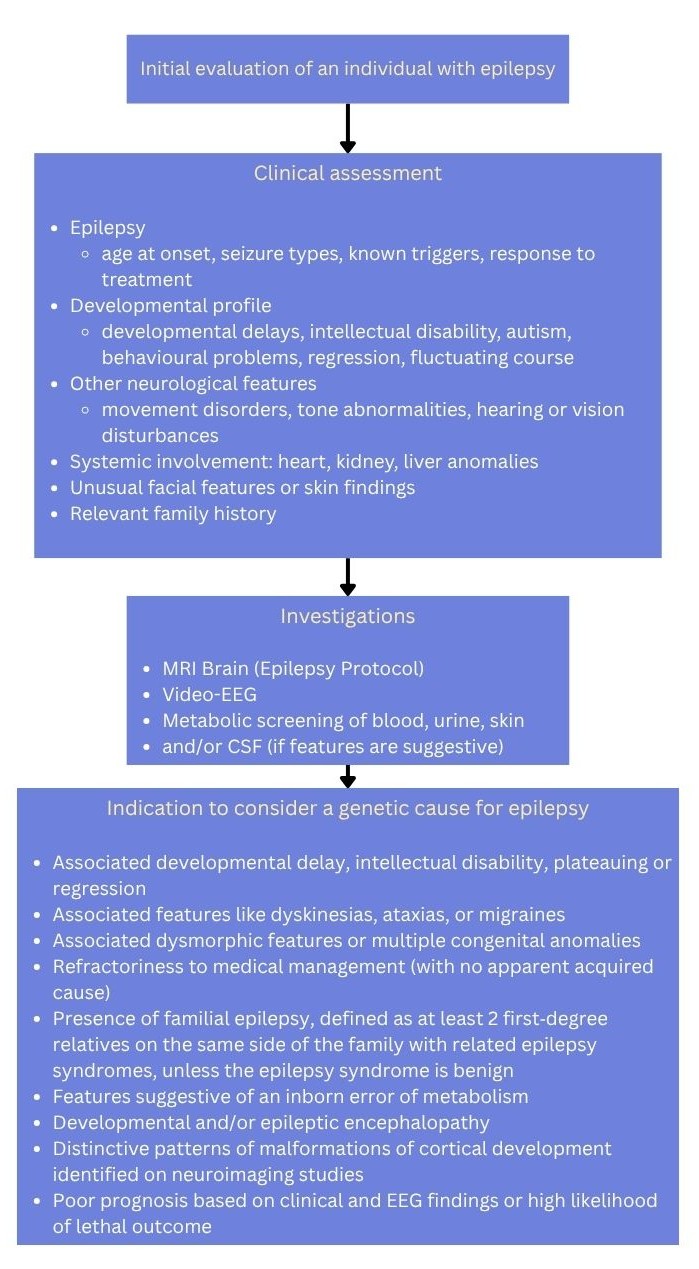
A detailed clinical evaluation is the first step. The electroencephalogram [EEG] is universally used as a diagnostic measure in epilepsy. Investigations like video-EEG and brain MRI are usually indicated where the etiology is uncertain, the seizures focal or prolonged, or the affected individual is refractory to antiepileptic drugs.
The figure below outlines clinical assessment and investigations of an individual with epilepsy including when to consider a genetic etiology:4
How do I order genetic testing?
Genetic testing is generally offered and ordered by a geneticist, neurologist or a specialist with expertise in neurogenetic conditions.
The ordering physician will perform a detailed clinical evaluation, including taking details of seizures/epilepsy and developmental profile, looking for associated neurological and other systemic co-morbidities or dysmorphisms, and taking a 3-generation family history.
A decision will be made about genetic testing. If testing is appropriate, the benefits, risks and limitations of the genetic testing chosen will be reviewed. The most appropriate testing approach will be determined by history and clinical presentation (e.g. single gene analysis, a gene panel analyzing a selected group of genes associated with a specific condition or set of symptoms, microarray detecting small extra or missing pieces of genetic information (microduplication/deletion), genome sequencing analyzing every gene in the entire genetic library.)
In Ontario, genetic testing guidance for neurogenetic conditions have been published by the Provincial Genetics Program.
Individuals with the following types of epilepsy do not require genetic testing:
- Isolated self-limited focal epilepsy
- Typical idiopathic generalized epilepsy (e.g. childhood absence epilepsy, juvenile myoclonic epilepsy)
- Isolated mesial temporal lobe epilepsy with hippocampal sclerosis
- A clearly acquired epilepsy (e.g. occurring secondary to head trauma, CNS infection, hypoxia)
Where do I refer my patient?
If the epilepsy is uncontrolled, referral to, or consultation with, a Comprehensive Epilepsy Centre/Program/ District or Regional Epilepsy Centre is recommended.
Alberta (& Northwest Territories) - See Alberta’s Referral Directory
Atlantic Canada - QEII Health Sciences Centre Epilepsy Program
British Columbia (& Yukon)
- Vancouver General Hospital Epilepsy Program
- BC Children’s Hospital Neurological Care Centre
Newfoundland and Labrador - Health Sciences Centre Neurology/Epilepsy Services
Ontario (& Nunavut) – Comprehensive Epilepsy Programs
Quebec
- The Neuro (Montreal Neurological Institute-Hospital) (McGill)
- CHUM Epilepsy Clinique
- CHU La clinique d’épilepsie
If epilepsy is well controlled, and there are dysmorphic features, consider referral to a clinical geneticist. Find the contact information for your local genetics centre here. If you have questions, you can always reach out to your local genetic centre and speak with a genetic counsellor or geneticist. Many provinces have eConsult where you can connect with a specialist. For the most meaningful appointment and appropriate triaging, it is important to include any previous investigations and consultation notes (e.g. genetic test results, psychological assessments, brain imaging) along with your referral.
If there is developmental regression or other clinical features suggestive of an inborn error of metabolism, consultation with a biochemical geneticist or a physician with training in inherited metabolic disorders is strongly recommended.
For community support and research opportunities for the affected person and their family, see Canadian Epilepsy Alliance.
What do the genetic test results mean?
The available genetic testing methods have variable reported yields in selected patient populations with epilepsy, for example, genomic microarray (yield 3-10%),5,6 targeted gene panels (yield 10-48.5%),7 whole exome sequencing (yield 11-72%)6 and whole genome sequencing (yield 38-48%).8 The variability in testing yields may be attributed to variation in the number of genes tested (in a targeted gene panel), research cohort size and inclusion criteria.
Possible results:
A positive result means a pathogenic/likely pathogenic (P/LP) in a gene(s) known to be associated epilepsy have been identified. This confirms a genetic condition. This result may have significant implications for treatment considerations, surveillance, further management and counselling of specific recurrence risks. Important considerations when interpreting genetic test results are variable expressivity (individuals with the same genetic test result can have different clinical presentations) and incomplete penetrance (not every individual with the same genetic test result will develop symptoms).
A negative result means that no genetic variants of clinical significance were identified in any of the genes analysed. This does not rule out the possibility of a genetic contribution to an individual’s clinical presentation. Additional epilepsy phenotyping and/or re-selection of appropriate genetic test or panel may be warranted.
A variant of unknown significance (VUS) means a variant in a gene where the significance is not yet known was identified. The laboratory cannot confidently determine if the gene variant identified is pathogenic or benign as available evidence is insufficient or conflicting. A board-certified genetic counsellor or a geneticist can help to interpret the laboratory report. No changes to screening or medical management are indicated. While family members are typically not offered genetic testing for a VUS in some cases further testing of the parents or other affected family members may be requested to clarify the interpretation of these variants. Clinics and laboratories differ in their re-contact protocols, but generally an individual would be encouraged to re-contact their genetics provider in 2-5 years for updates on re-classification of the VUS they carry. Re-classification of a VUS could mean the variant is now determined to be pathogenic or benign.
A word about VUSs: A VUS is a result that leaves ambiguity for an individual and their family depending on their experience, attitudes toward healthcare and education level, there may be an inappropriate expectation of increased monitoring based on the result.9,10 Discussions with healthcare practitioners are important in shaping a patient’s understanding of the result, managing uncertainty and setting expectations. 9,10 It is also important to note that the rate of VUS is reported to be significantly higher in those of non-European ancestry (e.g. Hispanic, African, Asian and Pacific Islander).11 This has to do with the lack of diversity in clinical and research contexts and the under-representation of non-European groups in genomic databases. 12
A secondary finding: Genetic testing may identify a P/LP variant in a gene unrelated to the primary indication for testing. For example, genetic testing ordered because of suspicion of a neurogenetic condition and then testing identifies a P/LP variant in a gene associated with hereditary breast cancer. These results often still have significant health implications for the individual and their relatives.
What are the benefits of genetic consultation [with or without genetic testing]?
Genetic testing may provide a specific diagnosis and may end the diagnostic odyssey. Further benefits may include:
Targeted treatment: Sometimes, the results of genetic testing may influence the ongoing treatment of seizures. For example, individuals with GLUT1 deficiency syndrome benefit from a ketogenic diet, avoidance of sodium channel blockers will help in Dravet syndrome, and there are various vitamin-responsive epilepsies.13
Appropriate surveillance: Depending on the gene and the expected inheritance, ‘at risk’ family members can be screened for the same genetic variant.
Information on natural history: Once a genetic diagnosis is obtained, a more specific prognosis, with regard to epilepsy and other neurological co-morbidities, can be explained to the affected person or their parents. Focused systemic surveillance measures may be initiated. For example, a diagnosis of Tuberous Sclerosis will lead to recommendations for periodic surveillance for brain, kidney, and heart tumours.
Recurrence risk counselling can be more accurate once the gene involved and the mode of inheritance are known. Options for prenatal diagnosis in future pregnancies may be discussed. In the absence of a molecular diagnosis, recurrence risk counselling based solely on empiric risks can be provided to at-risk individuals (e.g. a first degree relative of the affected person).
A genetic diagnosis may also help the family to network with support groups and research collaborations.
Genetic consultation may also be valuable even in absence of genetic testing. It may provide the affected person/family more information about the disease under consideration, short- and long-term psychosocial support, and help to formulate future goals and facilitate family communication.
What are the limitations and complexities of genetic testing for epilepsy?
Uninformative results: An uninformative result cannot diagnose or rule out any particular genetic condition. This is the case when genetic testing is negative or when a variant of uncertain significance is identified.
Genetic heterogeneity: A broad epilepsy group may have a number of causative genes. For example, a progressive myoclonic epilepsy phenotype may be caused by mutations in genes CSTB, EPM2A, KCNC1, PPT1, TPP1, etc.
Variable expressivity: The same gene mutation may result in very different clinical phenotypes. The severity of epilepsy may be very variable. For example, missense mutations in SCN1A can present as simple febrile seizures, febrile seizure plus, or Dravet syndrome.14
Incomplete penetrance: Some individuals who carry a gene mutation may never develop symptoms of the disease. For example, a missense mutation in SCN1A has 60-70% penetrance.
Surveillance and Management
A genetic diagnosis may provide information about the natural history of the epilepsy syndrome, response to specific drugs, associated neurological and other systemic co-morbidities, and prognosis. This may guide the clinical and investigation-based follow up.
A positive genetic test result can direct the testing of “at-risk” family members (cascade testing).
Individuals with epilepsy contemplating pregnancy can be informed of the risks associated with certain anti-epileptic medication (e.g. valproic acid), the likelihood the medication will cause congenital anomalies or intellectual disability, and risks related to breastfeeding. 15
Resources
Epilepsy resources:
Canadian Epilepsy Alliance: a Canada-wide network of grassroots organizations dedicated to the promotion of independence and quality of life for people with epilepsy and their families, through support services, information, and public awareness.
References
- Weber YG, Biskup S, Helbig KL, Von Spiczak S, Lerche H. The role of genetic testing in epilepsy diagnosis and management. Expert Rev Mol Diagn.2017; 17(8): 739-750.
- Fiest KM, Sauro KM, Wiebe S, Patten SB, Kwon C, Dykeman J, et al. Prevalence and incidence of epilepsy: A systematic review and meta-analysis of international studies. Neurology. 2017; 88(3): 296-303.
- Helbig I, Heinzen EL, Mefford HC. ILAE Genetics Commission. Primer Part 1-The building blocks of epilepsy genetics. 2016; 57(6): 861-8.
- Jain P, Andrade D, Donner E, Dyment D, Prasad AN, Goobie S, et al. Development of Criteria for Epilepsy Genetic Testing in Ontario, Canada. Can J Neurol Sci. 2018; 00:1-7. doi:10.1017/cjn.2018.341.
- Sands TT, Choi H. Genetic Testing in Pediatric Epilepsy. Curr Neurol Neurosci Rep.2017; 17(5): E45
- Poduri A. When Should Genetic Testing Be Performed in Epilepsy Patients? Epilepsy Curr.2017; 17(1): 16-22.
- Mercimek-Mahmutoglu S, Patel J, Cordeiro D, Hewson S, Callen D, Donner EJ, et al. Diagnostic yield of genetic testing in epileptic encephalopathy in childhood. Epilepsia. 2015; 56(5) :707-716.
- Sheidley BR, Malinowski J, Bergner AL, Bier L, Gloss DS, Mu W, Mulhern MM, Partack EJ, Poduri A. Genetic testing for the epilepsies: A systematic review. Epilepsia. 2022 Feb;63(2):375-387. Ndugga-Kabuye MK, Issaka RB. Inequities in multi-gene hereditary cancer testing: lower diagnostic yield and higher VUS rate in individuals who identify as Hispanic, African or Asian and Pacific Islander as compared to European. Fam Cancer. 2019 Oct;18(4):465-469
- Mighton C, Clausen M, Shickh S, Baxter NN, Scheer A, Sebastian A, Muir SM, Kim THM, Glogowski E, Schrader KA, Regier DA, Kim RH, Lerner-Ellis J, Bayoumi AM, Thorpe KE, Bombard Y. How do members of the public expect to use variants of uncertain significance in their health care? A population-based survey. Genet Med. 2023 May;25(5):100819
- Ahsan MD, Levi SR, Webster EM, et al. Do people with hereditary cancer syndromes inform their at-risk relatives? A systematic review and meta-analysis. PEC Innov. 2023 Feb 17;2:100138
- Appelbaum PS, Burke W, Parens E, Zeevi DA, Arbour L, Garrison NA, Bonham VL, Chung WK. Is there a way to reduce the inequity in variant interpretation on the basis of ancestry? Am J Hum Genet. 2022 Jun 2;109(6):981-988
- Sharma S, Prasad AN. Inborn Errors of Metabolism and Epilepsy: Current Understanding, Diagnosis, and Treatment Approaches. Int J Mol Sci.2017; 18(7): E1384.
- Ottman R, Hirose S, Jain S, Lerche H, Lopes-Cendes I, Noebels JL, et al. Genetic testing in the epilepsies-report of the ILAE Genetics Commission. Epilepsia. 2010; 51(4): 655–70.
- Epilepsy Implementation Task Force, Provincial Guidelines for the Management of Epilepsy in Adults and Children, Version 1.0, January 2015, Critical Care Services Ontario (accessed July 2026, http://epilepsyontario.org/wp-content/uploads/2015/03/Provincial-Guidelines-for-the-Management-of-Epilepsy-in-Adults-and-Children_Janurary-20151.pdf).
Authors: P Jain MD, DM, D Dyment MD, FRCPC, O.C Snead III MD, FRCPC
Edited by the GECKO team: S Morrison MS CGC, JE Allanson MD FRCPC FCCMG and JC Carroll MD CCFP.
Disclaimer:
· GECKO is an independent not-for-profit program that does not accept support from commercial or non-academic entities.
· GECKO aims to aid the practicing non-genetics clinician by providing informed resources regarding genetic/genomic conditions, services and technologies that have been developed in a rigorous and evidence-based manner with periodic updating. The content on the GECKO site is for educational purposes only. No resource should be used as a substitute for clinical judgement. GECKO assumes no responsibility or liability resulting from the use of information contained herein.
· All clinicians using this site are encouraged to consult local genetics clinics, medical geneticists, or specialists for clarification of questions that arise relating to specific patient problems.
· All patients should seek the advice of their own physician or other qualified clinician regarding any medical questions or conditions.
· External links are selected and reviewed at the time a page is published. However, GECKO is not responsible for the content of external websites. The inclusion of a link to an external website from GECKO should not be understood to be an endorsement of that website or the site’s owners (or their products/services).
· We strive to provide accurate, timely, unbiased, and up-to-date information on this site, and make every attempt to ensure the integrity of the site. However, it is possible that the information contained here may contain inaccuracies or errors for which neither GECKO nor its funding agencies assume responsibility.